
Gamification goes far beyond simple badges or points. It’s a research-driven approach for fostering genuine engagement and sustained employee motivation.
This article introduces proven gamification frameworks HR leaders can apply to enhance recognition programs, improve learning, and support culture.
From Octalysis to Self-Determination Theory, you’ll find practical models for building systems that spark action and deepen connection.
With solutions like the Esteeme platform, bringing these frameworks into everyday workflows becomes effortless, helping teams scale motivation, feedback, and recognition.
Using Gamification in HR: How It Works with Modern Game Elements
Motivating employees now goes far beyond traditional compensation. People want a sense of purpose, acknowledgment, growth, and independence. Incorporating game mechanics into non-game situations allows organizations to create experiences that fulfil those expectations. The term gamification describes the use of game design elements in contexts such as the workplace, education, or employee engagement.
By applying gamification, HR teams can shift from sporadic incentives to a structured model of behavior design. Certain elements, such as nudges, rewards, progress monitoring, and peer recognition, become deeply ingrained in how employees work. Research indicates that gamified HR practices can enhance both employee engagement and overall job satisfaction.
So, where do you start? What frameworks or models can help you organize HR gamification strategies in a way that leads to measurable results? Let’s explore the most impactful frameworks, examine practical "gamification examples", and highlight how platforms like Esteeme can facilitate implementation.
1. Octalysis Framework by Yu-kai Chou
The Octalysis Framework, one of the most widely used models in modern gamification, breaks motivation into eight “core drives”:
Meaning (e.g., purpose, calling)
Accomplishment (e.g., achieving goals)
Empowerment (e.g., autonomy and creativity)
Ownership (e.g., rewards, progress)
Social Influence (e.g., status, recognition)
Scarcity (e.g., time-bound rewards)
Unpredictability (e.g., surprise mechanics)
Avoidance (e.g., fear of missing out)
The current model illustrates how individuals respond to various game design components and how these can be leveraged to effectively "gamify" HR processes and other areas.
Major Advantages of Using Gamification to Strengthen Culture, Improve Retention, and Enhance Performance
Apply this model to map the emotional drivers behind your employee engagement or recognition strategies. For instance:
Blend Social Influence with Accomplishment to build peer-to-peer recognition campaigns—for example, badges for “top recognizer” or tiered status levels
Blend Scarcity with Unpredictability through time-bound challenges (e.g., encouraging employees to join a team challenge before the end of the month)
Blend Ownership with Empowerment by giving employees options in how they earn rewards or acknowledge peers.
The Esteeme platform makes this much easier by providing built-in challenges, progress visualization, and recognition tracking — removing the need to create these components from scratch and enabling you to use a dedicated platform.
Quick Example of Gamification
Picture a company that implements a recognition program in which employees collect points for recognizing colleagues, with the top three each month awarded status badges and minor perks. This illustrates gamification in practice, where game mechanics such as leaderboards and levels are applied to influence behavior.
2. Self-Determination Theory (SDT)
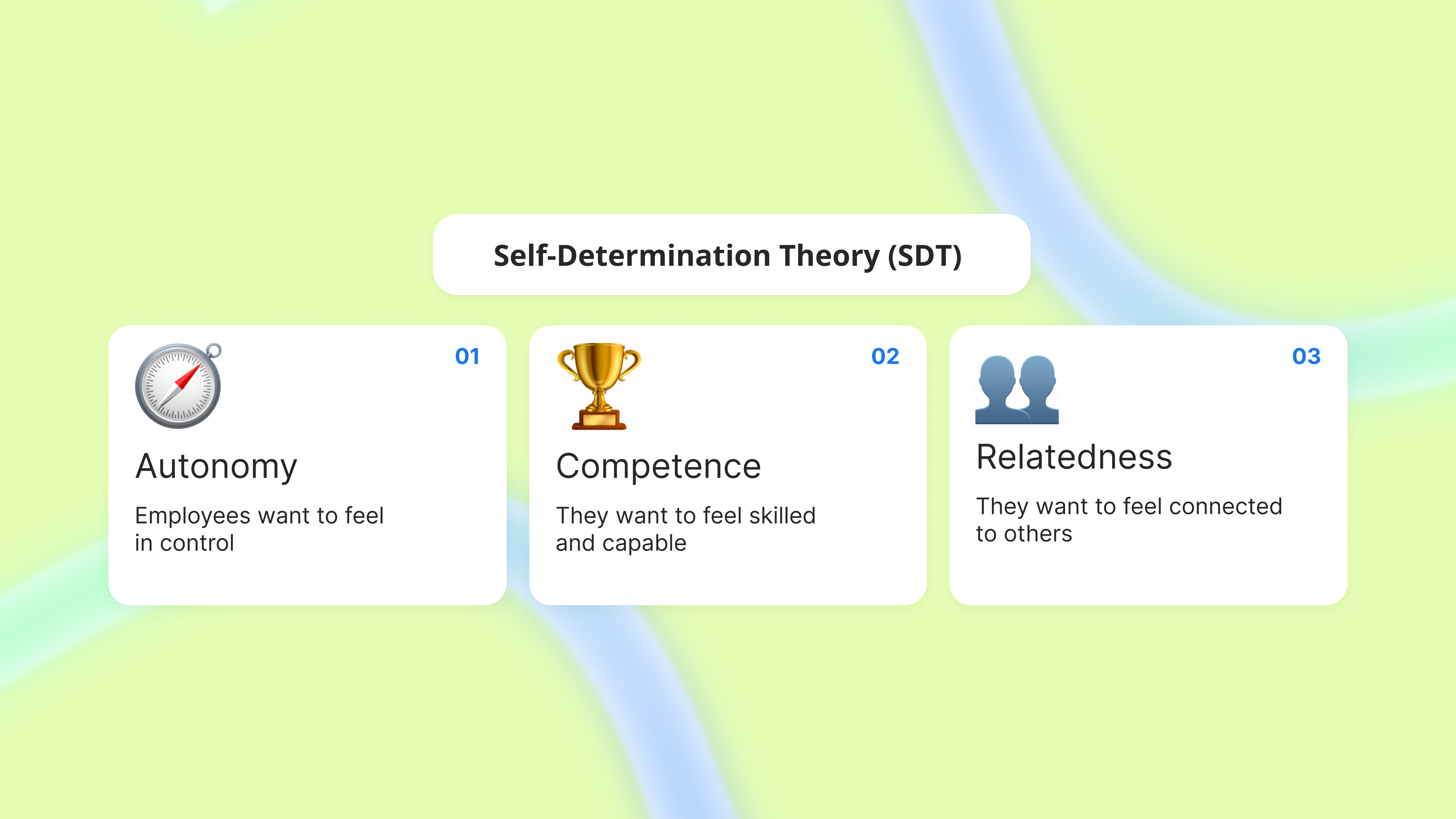
Self-Determination Theory centers on intrinsic motivation and identifies three fundamental needs:
Autonomy – the desire to feel in control of employees’ actions
Competence – the desire to feel capable and effective
Relatedness – the desire to feel connected with others
Incorporating gamification into learning and development, onboarding, or culture-change initiatives goes beyond adding rewards—it actively addresses these psychological needs. Studies have demonstrated that employees who feel autonomous, competent, and connected exhibit higher levels of motivation and engagement.
HR Use Case
Give employees choice (autonomy) – they decide which “missions” or training modules to engage with.
Provide skill badges or progressive recognition (competence) – enabling them to earn credentials and advance in their skills.
Encourage team challenges or peer recognition (relatedness) – creating connections across the organisation.
Platforms like Esteeme support “Smart Events,” where employees complete tasks or mentoring sessions, gain recognition points, and connect with peers—demonstrating how gamified engagement and learning programs can be implemented.
Focusing on these three needs ensures your gamification efforts are purposeful, not just entertaining.
3. SAPS Rewards Model (Status, Access, Power, Stuff)
Another valuable framework for designing rewards is the SAPS model, developed by Gabe Zichermann. It categorises non-monetary rewards into four key types:
Status – public recognition, rank, or titles that signal achievement and respect among peers. Examples include “Employee of the Month,” leaderboard positions, or badges highlighting expertise. Status appeals to the human desire for social validation and acknowledgment.
Access – exclusive opportunities or privileges unavailable to everyone, such as VIP invitations, early access to new tools, or direct engagement with leaders or mentors. Access makes employees feel valued and “in the know.”
Power – the ability to influence decisions, shape workflows, or mentor others. This could involve leading projects, providing input on strategic initiatives, or guiding junior colleagues. Power satisfies the need to have impact and agency at work.
Stuff – tangible rewards or tokens, including gift cards, merchandise, or coins. While often the most obvious form of reward, “stuff” typically has a shorter-term motivational effect compared to status, access, and power.
In workplace gamification, the SAPS model enables organizations to design reward systems that extend beyond monetary incentives. Many companies mistakenly focus only on “stuff,” but status, access, and power often drive behaviour more sustainably and meaningfully.
HR Use Case
Implementing a tiered reward system with Bronze, Silver, and Gold levels adds clear progression and motivation. Employees achieving Bronze could earn a status badge, Silver might unlock access to special workshops, and Gold could offer the authority to lead a project, plus a tangible reward.
Gamification platforms, such as Esteeme, enable organizations to efficiently manage and scale these symbolic and physical rewards across teams.
This method illustrates that gamification is not merely about mechanics—it provides a framework for designing reward systems that encourage purposeful behaviors and sustained engagement.
4. Fogg Behavior Model (FBM)
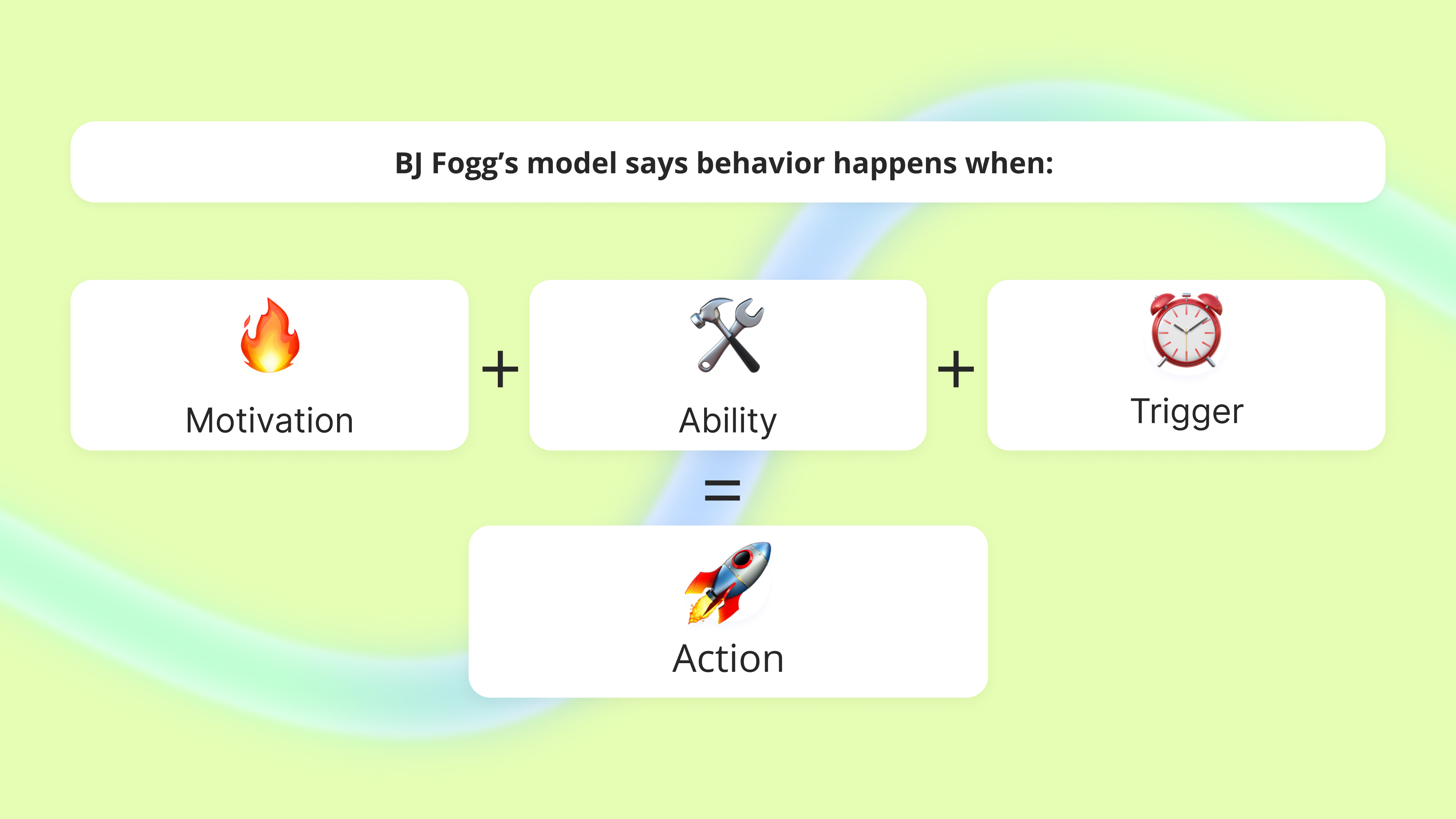
The Fogg Behavior Model states that Behavior equals Motivation times Ability times Trigger. In other words, even with high motivation, if a task is too difficult or there’s no timely trigger, the behavior won’t occur. This model emphasizes the importance of designing tasks that are both manageable and provide clear prompts or cues. By balancing motivation, ability, and triggers, organizations can more effectively encourage desired behaviors in employees.
HR Use Case
If you want employees to complete peer nominations each quarter:
Make the nomination form short and mobile-friendly (ability)
Recognise progress (motivation)
Trigger reminders after project milestones (trigger)
Platforms like Esteeme automate this using behavior-based nudges — a foundation of effective gamification in HR.
5. Flow Theory (Mihaly Csikszentmihalyi)
Flow happens when a person becomes fully absorbed in a task that matches the skill level with the challenge at hand. Tasks that are too simple result in boredom, while tasks that are too complex can cause frustration. Maintaining flow requires providing just enough challenge to push abilities without overwhelming them. Immediate feedback and clear objectives help sustain focus and momentum. In professional settings, flow can be encouraged through carefully structured projects, gamified tasks, or progressive skill-building activities. When employees enter a state of flow, they often show higher productivity, creativity, and enjoyment in their work. Designing tasks with flow in mind ensures that engagement and learning are both maximized.
Too easy = boredom. Too hard = frustration.
HR Use Case
Use levels to break tasks into manageable stages, following proven game design principles.
Introduce more challenging tasks as employees’ skills improve to maintain engagement and encourage continued growth.
Offer feedback, track milestones, and award badges to recognise achievements along the way.
Adjust difficulty dynamically to match performance, ensuring learners remain challenged but not discouraged.
In a gamified learning system, employees could progress from “Level 1: Basics of Compliance” to “Level 2: Advanced”, experiencing a clear sense of achievement with each step. Combining progression with immediate feedback encourages continuous improvement and sustained attention. Recognition through badges or points reinforces effort and fosters a sense of accomplishment. Platforms such as Esteeme support this approach by providing levels, coins, and dashboards that make engagement measurable and consistent.
🎥 Real-World Implementation: Bringing It All Together
Campaign Example: “Mission Engage – Q4 2025”
Onboarding / Learning
Use Flow Theory & SDT to create missions with autonomy, competence, and relatedness.
Apply Octalysis for purpose, ownership, and social influence.
Recognition & Feedback
Use SAPS & Octalysis to tier rewards and status levels. Together, these models help you design structured pathways where each reward level is connected to a specific psychological driver. Tiering rewards through SAPS and Octalysis ensures that recognition feels justified and aligned with goals. Employees gain clarity on how to advance and what behaviors are reinforced at each level. This layered reward structure builds anticipation and supports sustained engagement over time.
Automate reminders via FBM triggers. Using FBM-aligned triggers ensures reminders are sent exactly when employees are most likely to act. Automated prompts reduce reliance on manual follow-ups and keep activities at the forefront of mind. This not only increases completion rates but also strengthens habit formation. When reminders are aligned with an individual's ability and motivation, behavior change becomes more predictable and consistent.
Compliance / Training
Combine Flow with game-based learning using micro-modules and surprise badges. This way, learners stay curious, motivated, and eager to see what comes next..
Wellness & Culture
Incorporate game elements, such as points and challenges, to engage players and foster a strong community culture. These features motivate people to take part more actively and celebrate achievements together. They also promote friendly competition and collaboration, making interactions more dynamic. As engagement grows, the workplace naturally becomes more connected and energised.
Track metrics — including participation, satisfaction, and retention — and tie them to outcomes. Platforms like Esteeme provide the analytics backbone to make gamification at work measurable.
✅ Final Checklist for Effective Learning and Adoption
Define objectives clearly.
Identify intrinsic motivators through the SDT.
Select game design elements that align with these motivators.
Develop a reward system guided by the SAPS model.
Ensure actions are simple and accessible, in line with the FBM.
Create a sense of progression inspired by the Flow model.
Ensure your metrics accurately reflect desired outcomes.
Use a gamification platform that can scale with your needs.
Run a pilot, gather feedback, and iterate.
Maintain an inclusive and ethical approach.
“Gamification isn’t a magic bullet—design thoughtfully.”
🧭 Applying This Beyond HR: Other Domains
Gamification in Education
Game-based learning in education boosts both student motivation and long-term retention of material. Elements such as micro-badges, leaderboards, and online learning platforms demonstrate how gamification can elevate learning performance. These features break learning into manageable milestones that feel rewarding to complete. They also encourage consistent participation by making progress visible and meaningful. As a result, students experience a more dynamic and engaging learning process.
Gamification in Health and Wellness
In the health and wellness space (e.g., fitness app programs), gamification solutions encourage healthy habits through streaks and challenges. These mechanics motivate users to stay consistent by rewarding daily effort and visible progress. They also help transform wellness routines into engaging, game-like experiences that feel less like chores. Over time, this consistent positive reinforcement supports long-term behavior change and improved overall well-being.
Gamification in Business & Marketing
Marketing campaigns rely on loyalty mechanics to engage users' interest and drive repeated engagement. By offering points, badges, or exclusive benefits, they encourage users to interact more often and with greater enthusiasm. These mechanics also reinforce positive brand perception by making each touchpoint feel rewarding. The power of gamification lies in aligning value for both the user and the organization, creating a mutually beneficial experience. When expectations and outcomes match, participation naturally increases.
🧠 Deep Dive: How to Think About Game Design in HR
When a game designer applies game design elements and principles to work systems, HR can do the same to make processes more engaging:
Storytelling and context help employees understand why tasks are important and foster an emotional connection.
Progression and mastery support continuous learning and skill development over time.
Feedback loops reinforce desired behaviors and help employees course-correct quickly.
Social engagement encourages collaboration and healthy competition.
Voluntary participation empowers individuals to choose how they engage, increasing intrinsic motivation.
Scalable systems ensure these approaches grow with the organization and remain effective as teams expand.
Using the integration of gamification across HRIS and learning platforms unifies the experience and maintains consistency. This creates a seamless environment where employees feel motivated and supported throughout their journey.
🔍 Sample Implementation Timeline
Month 1 – Strategy & Design Establish clear goals, select the guiding frameworks, and outline the supporting technology stack.
Month 2 – Pilot Launch Deploy onboarding missions, configure key game mechanics, and automate triggers to support engagement.
Month 3 – Measure & Iterate Monitor engagement data, gather satisfaction insights, and adjust the user experience accordingly.
Month 4 – Scale & Integrate Extend the initiative across teams, connect it to core platforms, and share progress updates.
Month 5–6 – Continuous Refinement Introduce new challenges, refine existing elements, and maintain a tight connection between the system and its desired outcomes.
🔧 The Way
Platforms like Esteeme simplify end-to-end gamification, offering the following:
Built-in frameworks (Octalysis, SDT, SAPS)
Recognition and learning integrations
Dashboards for measurable outcomes
Global scalability
With Esteeme, HR teams can seamlessly add gamification—turning programs into measurable, motivating, and inclusive experiences.
💡 Ready to implement gamification at work? Start small, measure impact, and watch engagement grow—because effective gamification is about people first, and platforms sec
FAQs
- Gamification is the application of game design elements in non-game contexts, such as HR programs. It helps motivate users, drive completion, and increase retention.
- By embedding game mechanics—such as points, badges, and levels—into learning programs, organizations make training interactive, measurable, and more engaging.
- Examples include onboarding missions with badges, leaderboards for peer recognition, and team challenges focused on wellness. These elements boost participation, motivation, and overall engagement.
- Design gamification around principles of autonomy, competence, and relatedness. Ensure the system aligns with professional development and career growth.
- Gamification increases engagement, motivation, retention, and productivity by integrating game-inspired elements into daily routines.
- Common pitfalls include overly complex design, unhealthy competition, lack of measurement, or poor integration into existing processes.
Related articles
See all Posts
Best Employee Recognition Software for Healthcare (2026)